Understanding the Condition
The kidneys are essential organs that help maintain the body’s balance by filtering waste products from the blood, regulating fluid levels, and producing hormones involved in blood pressure control and red blood cell production.
Like many organs, the kidneys can develop different types of tumor. Some kidney lesions are benign and may only require monitoring, while others are malignant and may require further investigation or treatment.
At Nordic Focal Therapies, we specialise in the diagnosis and image-guided management of selected kidney tumor. Through advanced imaging and minimally invasive expertise, we help patients understand their condition and explore treatment options tailored to their individual situation.
What Are Kidney Tumor?
A kidney tumour is an abnormal growth of cells within the kidney. Kidney tumor can be classified as either benign or malignant depending on their biological behaviour.
The most common malignant kidney tumour is renal cell carcinoma (RCC), which develops from the cells lining the small filtering structures of the kidney.
Many kidney tumor are discovered incidentally during imaging performed for unrelated reasons. As imaging technology has improved, smaller kidney tumor are being detected earlier, allowing more treatment options that focus on preserving kidney function.
Types of Kidney Tumor
Renal Cell Carcinoma
Renal cell carcinoma is the most common type of kidney cancer in adults.
There are several subtypes of renal cell carcinoma, including:
Clear cell renal cell carcinoma
Papillary renal cell carcinoma
Chromophobe renal cell carcinoma
Treatment decisions depend on several factors, including tumour size, location, growth pattern, kidney function, and the patient’s overall health.
For selected small kidney tumor, minimally invasive image-guided treatments may provide effective local tumour control while preserving healthy kidney tissue.
Small Renal Masses
Small renal masses are kidney lesions that are often discovered unexpectedly during imaging.
Not every small renal mass behaves aggressively. Some may grow slowly and can be monitored carefully, while others may require treatment.
Specialist assessment helps determine whether the most appropriate approach is:
Active surveillance
Further imaging
Biopsy
Minimally invasive treatment
Surgical management
Benign Kidney Tumor
Some kidney lesions are non-cancerous.
Examples include:
Renal oncocytomas
Angiomyolipomas (AML)
Simple kidney cysts
Although many benign kidney lesions do not require treatment, some may require monitoring or intervention depending on their size, growth, symptoms, or risk of complications.
Symptoms of Kidney Tumor
Many kidney tumor do not cause symptoms in their early stages. As a result, they are often discovered incidentally during CT or ultrasound examinations performed for another reason.
When symptoms occur, they may include:
Blood in the urine (haematuria)
Pain in the side or lower back
A palpable mass in the abdomen or side
Unexplained weight loss
Fatigue
Reduced appetite
Persistent fever without an obvious cause
These symptoms can have many causes, which is why accurate imaging and specialist evaluation are important.
How Kidney Tumor Are Diagnosed
Accurate diagnosis helps determine the most appropriate management approach.
Assessment usually combines imaging, medical history, laboratory tests, and sometimes tissue sampling.
CT Imaging
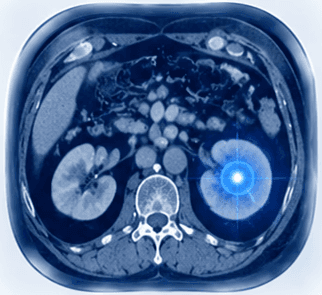
Contrast-enhanced CT is one of the most important imaging methods for evaluating kidney tumor.
CT provides detailed information about:
Tumour size
Exact location within the kidney
Relationship to blood vessels and collecting structures
Features that help distinguish different types of lesions
This information is essential for treatment planning.
MRI
MRI provides detailed soft tissue imaging and can be useful when additional information is needed.
It may help evaluate:
Complex kidney lesions
Tumour characteristics
Relationship to nearby structures
Ultrasound
Ultrasound is commonly used as an initial imaging examination and provides real-time assessment of kidney abnormalities.
It can also support image-guided procedures when further investigation or treatment is required.
Image-Guided Kidney Tumour Biopsy
In some cases, imaging findings alone cannot determine the exact nature of a kidney lesion.
A biopsy may be recommended to obtain a small tissue sample for laboratory analysis.
Using CT or ultrasound guidance, specialists can precisely target the lesion while minimising trauma to surrounding healthy tissue.
Biopsy results can help guide decisions between monitoring, treatment, or additional investigation.
How Kidney Tumor Are Evaluated
Every kidney tumour requires an individual assessment.
Specialists consider factors including:
Tumour size
Tumour location within the kidney
Growth behaviour
Appearance on imaging
Kidney function
Patient age and overall health
Other medical conditions
Personal treatment goals
The goal is to choose an approach that balances effective tumour control with preservation of kidney function.
Preserving Kidney Function in Treatment Decisions
The kidneys play an important role in maintaining overall health. Whenever possible, modern kidney tumour management aims to preserve functioning kidney tissue.
For selected patients, treatment approaches can focus on:
Treating only the tumour area
Avoiding unnecessary removal of healthy kidney tissue
Maintaining long-term kidney function
This organ-preserving approach is an important principle in contemporary kidney tumour care.
The Role of Image-Guided Therapies
Advances in interventional radiology have expanded the options available for selected kidney tumour patients.
Image-guided techniques allow specialists to:
Precisely locate kidney lesions
Plan procedures around important anatomy
Obtain tissue samples when needed
Deliver targeted treatments while protecting surrounding structures
Advanced imaging is central to both diagnosis and treatment planning.
When Should You Seek Specialist Assessment?
A specialist review may be appropriate if you:
Have been diagnosed with a kidney tumour
Have an uncertain kidney lesion found on imaging
Have a growing renal mass
Want to understand treatment alternatives
Need an expert review of your imaging findings
Early assessment helps clarify the diagnosis and identify the most appropriate next steps.
Why Choose Nordic Focal Therapies?
Nordic Focal Therapies combines extensive university hospital experience with advanced image-guided minimally invasive medicine.
Our specialists have extensive experience in interventional radiology, including diagnostic procedures and targeted treatments for selected tumour conditions.
We believe that modern medicine should aim for:
Precision treatment. Preservation of healthy tissue.
Every patient is assessed individually, with decisions based on advanced imaging, medical expertise, and the patient’s personal goals.
Related Treatments
If you have been diagnosed with a kidney tumour, your specialist may discuss different treatment options depending on your individual situation.
Learn more about:
→ Image-Guided Tumour Treatments
→ Image-Guided Biopsies
→ Cryoablation
→ Microwave Ablation
Frequently Asked Questions
Are all kidney tumor cancerous?
No. Some kidney lesions are benign and may only require monitoring. Additional imaging or biopsy can help determine the nature of an uncertain kidney lesion.
How are kidney tumor usually discovered?
Many kidney tumor are found accidentally during CT, MRI, or ultrasound examinations performed for unrelated reasons.
Does every kidney tumour need treatment?
Not necessarily. Some small kidney tumor can be monitored carefully, while others may benefit from treatment depending on their characteristics.
Can kidney tumor be treated without removing the kidney?
In selected patients, minimally invasive and organ-preserving approaches may allow treatment of the tumour while maintaining healthy kidney tissue.
What happens after a kidney tumour diagnosis?
After diagnosis, specialists review imaging findings and medical information to determine whether monitoring, further investigation, or treatment is the most appropriate next step.